That feeling of dread before a race isn’t just nerves. It’s your body’s way of warning you about possible bike issues. When you start racing and hear an unexpected sound, it feels like the end. Panic is the last thing you want.
You don’t need to be a master mechanic. What’s key is to quickly figure out what’s wrong. Can you fix it fast with what you have? Or should you start running instead?
This approach is all about quick decisions. Is the fix quick, cheap, or is it too late? This mindset is your best tool.
The pros don’t just check their gear; they test it. They do a quick check before the race. That odd noise from your last ride? You’re checking it today. It turns fear into a plan.
Your bike should feel like a part of you, not a worry. A pre-race check is a diagnostic in itself. It’s about finding out what’s not right, not just what is. This quick check can make all the difference between a bad finish and a tough one.
Chain, shifting, and derailleur fixes
Your bike’s drivetrain is like a delicate orchestra. It needs all parts working together for smooth performance. But, if one part goes wrong, it can cause big problems, like grinding noises and frustration, on race day. A pre-race check is key to avoiding these issues.
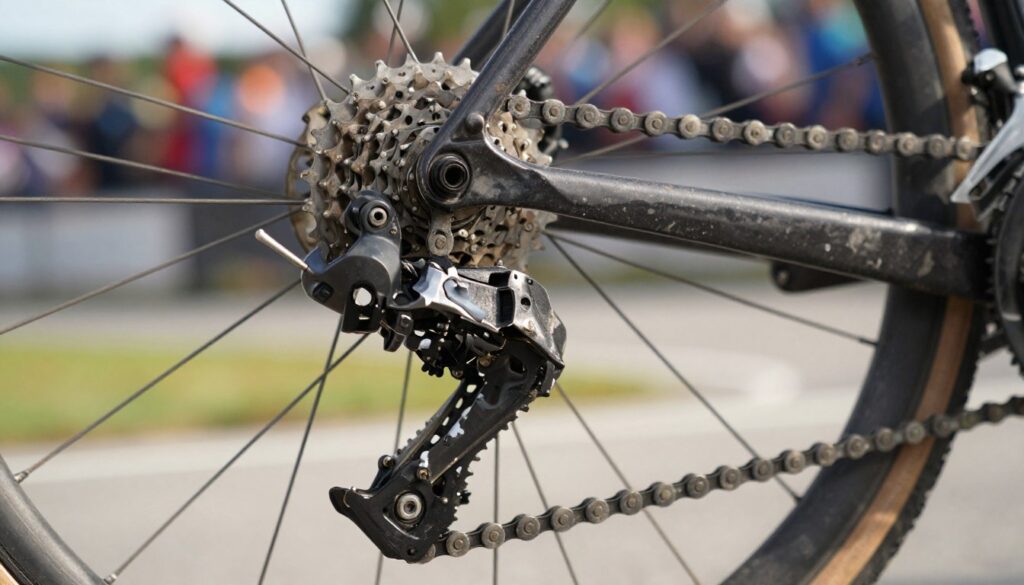
Your bike’s drivetrain is very sensitive. Even a small problem can cause big issues. A bent derailleur hanger, a bit of cable stretch, or a worn chain can all lead to trouble.
When Your Drivetrain Stages a Mutiny
Mechanical problems don’t care about your race plans. When they happen, it’s not just a small issue. It’s a big problem that can stop you from performing well.
The Dropped Chain
A dropped chain is a big embarrassment. It can happen when you’re racing fast. It might be due to a bent derailleur hanger, a worn chain, or a wrong limit screw setting. A quick check before the race can prevent this.
The Hesitant Shifter
When your shifter hesitates, it’s a sign of a problem. It might be a stretched or dirty cable. The fix is often simple, like tightening the cable or cleaning it.
The Ghost Shift
The ghost shift is a sneaky problem. It feels like the bike is shifting on its own. It’s usually caused by a bent derailleur hanger or a worn cassette. It’s hard to fix during a race, but a quick check can help.
| Problem | Likely Culprit | 60-Second Diagnosis & 60-Second Fix |
|---|---|---|
| The Dropped Chain | Bent derailleur hanger, worn chain, or incorrect limit screw adjustment. | If the chain is off, stop pedaling immediately. Manually re-route the chain. For a quick trailside check, visually inspect the hanger alignment and ensure the limit screws on the front derailleur aren’t set too wide. |
| The Hesitant Shifter | Stretched or gummy shift cable, dirty housing, or worn cable ends. | Shift to the smallest cog. Pull the cable housing taut at the derailleur, re-clamp the cable, and re-tension. A drop of light lube on the cable can help in a pinch. |
| The Ghost Shift | Bent derailleur hanger, worn cassette, or stretched chain. | This is rarely a quick fix. The best in-race triage is to avoid the gear where it happens. The real fix is a new chain, cassette, or a derailleur hanger alignment post-race. |
The table above is your quick guide. A dropped chain is a big problem. A hesitant shifter means something’s not working right. The ghost shift is a sign of deeper issues. Your job is to fix these problems before they ruin your race.
Brake rub and wheel issues
In the quiet moments before a race, hearing brake pads touch a rotor is bad. That soft shhh-shhh-shhh sound is your bike’s way of saying it’s unhappy. It’s a sign of brake rub and a wobbly wheel, problems that can cost you seconds and mess with your focus.
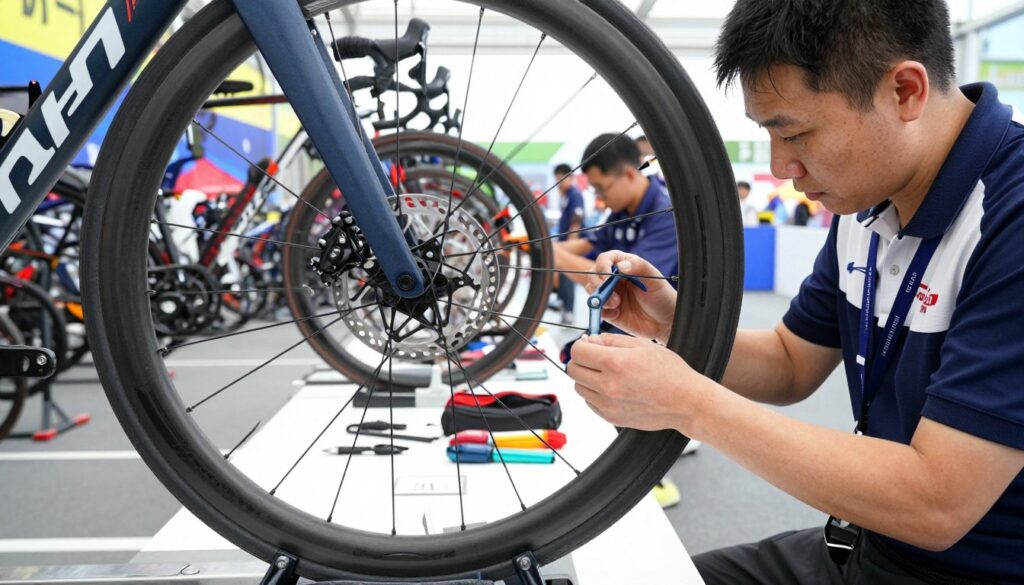
These issues play mind games with you before the race. You can ignore them or take a closer look. A careful check can help you fix these problems before they ruin your race.
The Screech of Doom and the Wobbly Wheel
The shhh-shhh-shhh sound of a rubbing brake is like a nagging roommate. It’s not loud, but it’s annoying and tells you something’s off. This is a common race day bike problem often caused by a misaligned brake or a wheel that’s not quite right.
Diagnosing the Rub
First, find where the sound is coming from. Lift the bike and spin the wheel. If the sound is constant, the wheel might be out of true. If the sound happens only when the wheel spins fast, it could be a brake or rotor issue.
Use the Winspace pre-race check to diagnose. Spin the wheels and listen. A quick brake check can also tell you if everything is working right.
A wobbly wheel is not just annoying; it’s a sign of imbalance. A wheel that wobbles is fighting itself. Watch how the gap between the rim and brake pads changes as you spin the wheel. If it moves, it’s a problem.
Before fixing the wheel, check the basics. Make sure the wheel is properly seated and the quick-release is tight. A wobbly wheel can often be fixed by just making sure it’s centered. If the wheel is true but the bike wobbles, the issue might be a tire that’s not on right.
Electrical and sensor failures
We’ve learned about chains, brakes, and tires. But today’s race bikes have a complex nervous system. This includes electrons and sensors. When these fail, you face a bike problem on race day that’s hard to fix.
This problem is about devices that don’t move but can fail. A dead Di2 battery is like a flat tire today. It’s a silent failure that can’t be fixed with a simple tool.
Before racing, we check everything. This includes a “final familiarization ride” for your bike’s systems. A “Three-Minute Check” before racing is now more than just for tire pressure.
When the Beeps Betray You
Beeps from your bike are signs of health. But when they stop, panic sets in. It’s not a mechanical issue but a digital silence.
Your bike’s electronics are always working. They’re checking and reporting. When they fail, it’s a big problem.
The Dead Head Unit
Your head unit’s screen is black. This is a big betrayal. It’s like your bike’s computer has stopped working.
To fix this, you need a simple checklist. Make sure the battery is fully charged before the race.
The Phantom Power Drain
A slow power drain is a sneaky problem. Your power meter or Di2 might seem fine but then fail. This is a ghostly issue that’s hard to find.
Before racing, plug everything in and check the lights. This is our way of trusting our bike’s systems.
The silent scream of a dead head unit: the modern cyclist’s nightmare.
Forums like Slowtwitch share stories of bike failures. A catastrophic power meter failure during an Ironman is one example. Always trust but verify your bike’s systems.
Here’s a quick guide to common electrical issues:
| Failure Point | Symptoms | Pre-Race Mitigation |
|---|---|---|
| Electronic Shifting (Di2/ETAP) | Sluggish shifts, no response, derailleur in “crash mode.” | Charge to 100% 2 nights before. Use manufacturer app to check battery level and firmware. |
| Head Unit / GPS | Blank screen, failure to acquire GPS, rapid battery drain. | Fully charge, pre-load course, disable Bluetooth/phone sync to save power. |
| Power Meter/Speed/Cadence Sensors | Dropouts, zero readings, or failure to pair. | Replace batteries pre-emptively. Pair and test all sensors on a short ride before race day. |
| Integrated Systems (Di2 with satellite buttons) | Buttons unresponsive, shifting lag. | Update all firmware. Ensure junction box is dry and connections are tight. |
The final check is more than just a glance. It’s a full systems diagnostic. This ensures you race with confidence, not as a cautionary tale.
When to fix vs. when to swap bikes
This is racecraft, the moment your mechanical crisis becomes a mental one. The chain is in the spokes, the rear derailleur hangs limp, and the peloton is disappearing. This is where the strategist separates from the merely strong.
The Triage Protocol
Think battlefield triage. The pre-race stress ride was your intelligence report. If a problem arises now, you have one question: can I make this bike race-worthy in the time I’ll lose? If the bike is no longer a tool but an adversary, the calculus changes.
The 60-Second Rule
Your heart is at 180 BPM. You have one minute. One. If a clear diagnosis and fix aren’t visible in that chaos, you are no longer fixing—you’re gambling. This is the 60-second rule. It’s the line between a strategic repair and a tactical retreat.
The Walk of Shame: A Cost-Benefit Analysis
Reframe the “walk of shame” as a strategic withdrawal. The goal is a bike that’s invisible—a perfect tool. When it becomes an adversary, the cost of fixing it mid-race often exceeds the cost of the walk. As the Winspace analysis suggests, sometimes the smartest tactical move is to minimize loss and fight another day. This isn’t quitting. It’s a Sun Tzu-level strategic redeployment of your resources—starting with your legs.
The sage racer knows victory isn’t just about the finish line. It’s about making the invisible decisions that keep you racing another day.