Ever wonder why your lap times won’t get better, even with an expensive carbon fiber wing? Meet your new brutally honest track companion – the performance data recorder.
Think of it as your car’s Fitbit, but it measures how well you brake, not steps. It’s not magic that will make you Lewis Hamilton overnight. It shows the truth about your driving.
Smartphone apps give some insight, but real data systems capture everything with precision. We spend on hardware, missing free seconds in our driving.
Experts say this tech “lifts the veil” on your performance. It shows the truth about your driving, like late braking or trail braking. It’s the difference between thinking you’re fast and really knowing where you’re slow.
Buying Guide
Choosing racing data loggers is like swiping through dating apps. You see endless profiles promising great things, but you’re not sure if they’ll show up. Do you choose the high-end system with lots of features you might not use, or the basic model that might not have enough?
Your first data logger should be like your first guitar. You don’t need a $3,000 Les Paul for your first try. The Aim Solo 2 DL is like the Toyota Corolla of data loggers. It’s reliable, does what you need, and won’t break the bank.
For beginners, start with the Aim Solo or Video VBOX systems. They’re great entry points that won’t overwhelm you. The fanciest logger is useless if you can’t understand the data.
Systems start around $500, but remember, it’s not just the hardware. You’ll also need a good laptop for the software. Don’t get something too old or weak.
Make sure the system works well with your computer. Most systems work better with Windows than MacOS. Also, think about if you can add more features later.
Smartphone apps like TrackAddict and RaceChrono are good alternatives. They turn your phone into a basic data logger, but they have some limits.
For better accuracy, consider adding an external GPS. Systems like VBOX are top-notch for pros, but they cost a lot.
The best racing data logger is the one you’ll use and understand. Start simple, learn the basics, and upgrade as you grow. Buying too much too soon is a waste.
Installation Steps
Installing a data logger is like doing open-heart surgery on your race car. It involves a lot of electrical tape and worry. The process can be simple or very complex, depending on the system.
Today, there are many options. Some systems are easy to use and don’t need tools. Others require a lot of work under the dashboard.
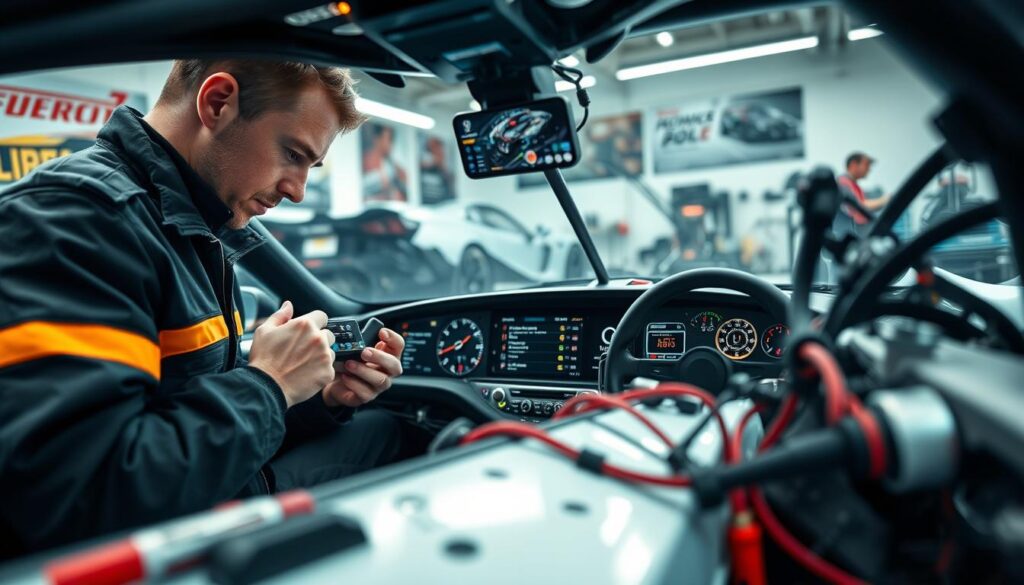
The power needs vary a lot. Some units just need a cigarette lighter plug. Others need a direct battery connection with the right fuses. Always check what your unit needs before you start.
Some systems come with sensors that work right away. Others need extra sensors and wiring. Think about what you need before you choose.
Working with the CAN bus is a big step. It lets your logger talk to your car’s systems. This gives you more data but requires some tech skills.
Where you put the sensors is very important. The right spot can make a big difference in the data quality. Common places include:
- Chassis mounting for accelerometers
- Wheel wells for suspension sensors
- Engine bay for temperature and pressure sensors
The number of channels you have limits how much data you can collect. Simple loggers might have 8 channels. More advanced ones can handle 32+ channels. Plan your setup carefully.
How often you sample data affects how detailed it is. Faster sampling rates give more detail but make bigger files. Think about what you need and how much space you have.
This comprehensive racecar data logger guide has more tips. It covers everything from simple setups to complex ones.
Here are some tips from experienced racers:
- Label every wire twice – trust us on this
- Photograph original configurations before disconnecting anything
- Keep a fire extinguisher nearby (electrical fires spoil weekends)
- Test systems incrementally, not all at once
Finding the perfect motorsport data logger tutorial is hard. Each installation is different. See it as part of the racing journey.
Getting it right turns raw data into useful racing insights. The right setup means you can analyze your performance better. This leads to faster lap times.
What to Record
Imagine data logging as a cocktail party. Most people try to talk to everyone, missing the best conversations. It’s like wanting to measure everything in a car, from tire temperatures to cabin humidity.
But, quality is more important than quantity. You don’t need to measure everything at once. Start with the basics that tell you a lot about your driving.
Speed, RPM, and throttle position are key. They are like the ABCs of car performance. Mastering these can help you understand your driving better than a therapist.
- How smoothly you’re applying power
- Where you’re losing momentum
- Whether you’re actually using all available power
- How your gear changes affect overall pace
Once you get the basics, add more essential parameters for deeper insights. These include:
Steering angle shows how much you’re fighting the car. Big inputs mean you’re overdriving. Small, precise movements are better.
GPS-based measurements make your data logger better. It shows lap times, cornering speeds, and acceleration patterns clearly.
The goal is to improve, not just collect data. Your data logger should be honest with you. It should tell you what you need to hear, not what you want to hear.
Organize your data into three groups: powertrain, chassis, and driver inputs. This helps you focus on what’s important. It prevents data overload and ensures you capture what matters most.
The best data recording strategy is one you’ll use and understand. Start simple, add more as you go. Remember, the numbers always tell the truth, even when they’re hard to hear.
How to Interpret Data
Ever felt like your data trace looks like a Pollock painting? You’re not alone. Seeing raw data for the first time can feel like trying to read Ulysses in Greek.
The key to data interpretation isn’t just looking at each line. It’s about seeing how they connect. That small throttle lift might cost you three tenths on corner exit. And that early turn-in? It’s another two tenths gone.
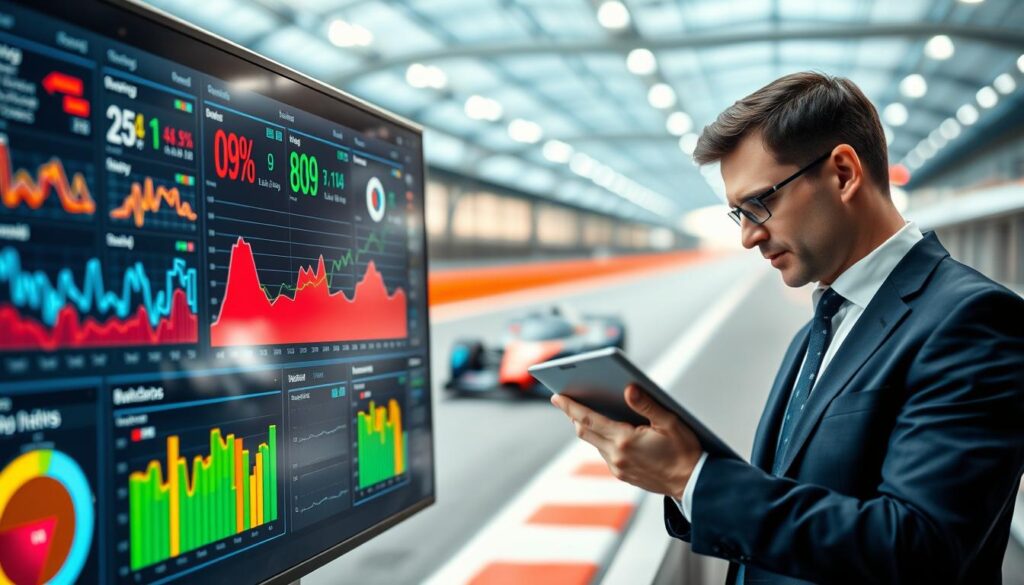
Real-time feedback makes this process magical. Modern systems give you instant results. It’s like having a crew chief who never gets carsick.
Graph interpretation begins with the basics. Look at throttle position versus steering angle, and brake pressure against lateral Gs. It’s like solving a mystery where the crime scene is your last lap.
Pattern recognition is what sets pros apart from amateurs. Instead of focusing on single data points, look for patterns. Does your speed always drop in the same corner? Is there a section where your braking is early?
Track mapping overlays your data on the circuit layout. Suddenly, those numbers tell a story of your lap. You can see where you’re gaining or losing time.
The real magic is in parameter correlation. Look at brake temperature versus lap times, or tire pressure changes versus cornering speeds. This is where you find those hidden tenths that make all the difference.
Remember, racing data analysis is about progress, not perfection. Each session adds a new chapter to your driving story. The lines on the screen are your map to the next personal best.
Common Pitfalls
Welcome to the moment when dreams meet reality – often with a price tag. The journey with a data logger isn’t always smooth. It can be like hitting a pothole at full speed.
The biggest mistake? Buying a top-notch system for a lower level of racing. It’s like using a high-tech missile to open a beer bottle. It’s overkill and could be dangerous.
Analysis paralysis is another trap. You spend too much time looking at graphs and not enough driving. Debating a small change in throttle while forgetting to brake is like a nervous dance.
Some people collect equipment instead of driving. $10,000 worth of sensors but can’t hit an apex. It’s like buying every kitchen gadget but can’t even toast bread.
Phone apps can also be a trap. Their accuracy is like using a rubber ruler. They’re okay for casual tracking, but for precision, you need real gear.
Track day rules can catch you off guard. Some places have strict rules about data recording. Being told to remove your system can ruin your session.
Here’s a key rule: The data should serve your driving, not become your driving. The numbers are your co-pilot, not the driver.
Don’t let technology take over the fun. Sometimes the best data point is the smile on your face after a perfect corner.
Success Stories
Data loggers turn confusion into clarity quickly. I’ve seen club racers shave seconds off their lap times. They did it by listening to their data about brake release points.
A Porsche enthusiast found out his late-apex habit cost him 0.8 seconds per lap. That’s a long time in racing. His data logger showed him that proper cornering was more important than aerodynamics.
A Miata driver learned her slow corner entries were costing her 5mph each turn. This change helped her go from mid-pack to podium finishes. Her data logger helped her understand her car’s messages for seasons.
These aren’t just engineering miracles. They show racers who treat data as their own language. The real win is when data turns into a roadmap for personal bests.
Your data logger has stories waiting to be found. The real question is, what secrets will your car share when you start listening?