Forget what you think you know about car parts that move up and down. This isn’t just about a smooth ride. It’s about the physics of control. Your suspension acts like the central nervous system of your car, linking your actions to the road.
It’s the difference between a ballerina and a linebacker trying to do a pirouette. The ballerina has grace and balance. The linebacker has mass but lacks grace.
We’re not just talking about making bumps smoother. We’re discussing the basic physics of how your car moves. It’s about turning your steering or brake inputs into direction changes.
This is where a driver becomes one with the car. It’s not magic; it’s mechanics. The aim is to keep tires firmly on the road, making your inputs count, not wasted energy.
Every tweak to a race suspension setup is a chat with physics. For more on the basics, check out our guide on race suspension tuning.
Forget just speeding in a straight line. This is about making physics your partner.
Sag and rebound explained
Your car’s suspension is like a good relationship. It’s about finding the right balance between support and forgiveness. If you get it wrong, you’ll have a bumpy ride. But if you get it right, your car will feel like an extension of you.
The key to this balance is sag and rebound. They are the foundation of suspension tuning. Ignore them, and your car will be unstable.
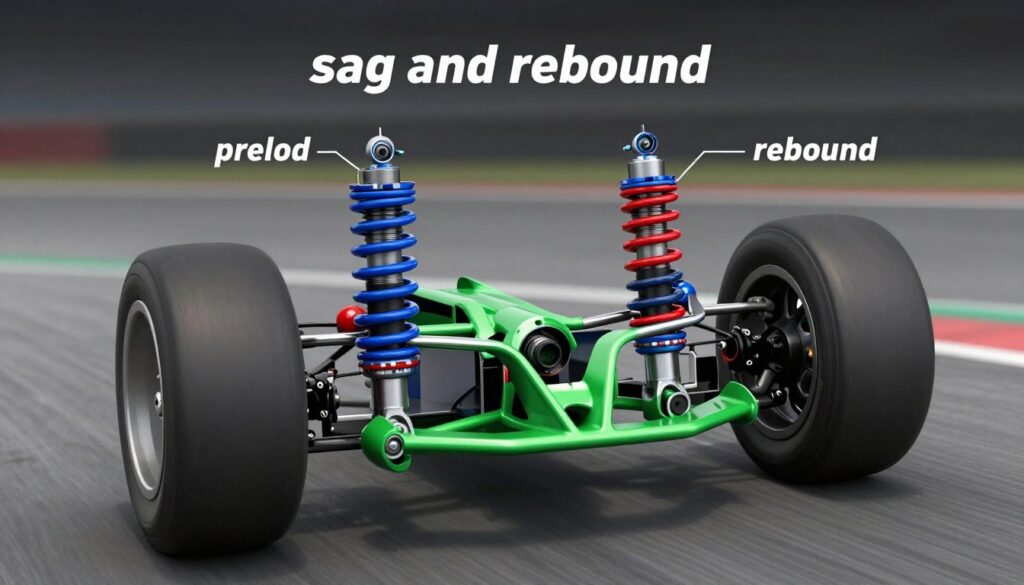
Sag and Preload
Let’s look at the car at rest. Here, sag is a critical measurement. It’s how much the suspension compresses under the car’s weight. Too much, and you lose travel before hitting a bump. Too little, and the car is too stiff.
The Role of Preload in Ride Height
Preload is the initial tension on the spring before the car’s weight is on it. It’s like setting the starting line. Adjusting preload changes the car’s ride height. Too much, and the car is too high. Too little, and it’s too low.
Getting this right ensures your suspension travel is used efficiently. It’s the first step in setting your car’s ride height.
How to Measure and Set Ride Height
Don’t rely on the parking lot eyeball test. Professional racers measure ride height with precision. Measure from the wheel hub to a fixed point on the fender. This is your ride height.
The goal is a consistent, level platform. Too high, and the car feels tippy. Too low, and you’ll scrape the undercarriage. It’s about finding the right balance for your suspension’s geometry.
Rebound and Compression
Shocks are the brain of your suspension. They control how fast the springs move. Rebound is the shock’s control over the spring’s return after a bump. Too much rebound, and the spring can’t move fast enough. Too little, and the car will bounce uncontrollably.
High-Speed vs. Low-Speed Damping
Damping isn’t one-size-fits-all. Your suspension needs to handle different events. Low-speed damping controls body roll in corners. High-speed damping handles sharp impacts.
A good setup balances both. Get this wrong, and your car will be either too soft in corners or too harsh on straights.
Mastering sag and rebound is about understanding your car and the road. When everything is in harmony, your car communicates with you. It’s the difference between driving parts and piloting a machine. This feeling will improve your lap times more than horsepower alone.
Terrain-specific tuning
Forget one-size-fits-all; in the world of suspension, the terrain is the ultimate teacher. A billiard-smooth Grand Prix circuit and a bumpy, undulating backroad demand completely different personalities from your suspension. This is where the real art of chassis tuning happens—listening to what the asphalt is telling you and responding with precision. It’s not just about making the car stick; it’s about making it communicate.
Circuit Tuning: Smooth vs. Bumpy Tracks
Think of a track’s surface as its personality. A freshly-paved, billiard-smooth F1-grade circuit rewards a stiff, low-slung aero car. A bumpy, patched-up club circuit with elevation changes? That’s a different beast entirely. Your setup needs to speak the track’s language.
Adjusting for High-Speed Stability
On a smooth, fast circuit, the enemy isn’t bumps—it’s air. High-speed stability is king. You’re fighting aero balance and keeping the platform stable for maximum downforce. This means a stiffer setup. You’ll run higher spring rates to minimize pitch and roll, and firm up the dampers to control the car’s mass transfer under heavy braking and high-speed cornering. Think of it as tuning for a fighter jet; precision and stability at the edge of adhesion are everything.
Tuning for High-Downforce vs. Mechanical Grip
This is the classic aero vs. mechanical grip debate. A high-downforce, smooth-track car is like a one-trick pony: incredibly fast when it’s in its element, but a fish out of water elsewhere. For a bumpy, technical track, you need mechanical grip. You soften the suspension to let the tires follow the undulations and maintain contact. It’s the difference between a scalpel and a Swiss Army knife. You can learn more about adapting to loose or uneven surfaces in our guide to tuning dirt racing suspensions, where terrain is the ultimate variable.
The Tools for the Job: Sway Bars, Springs, and Bump Stops
You can’t fight the terrain with just wishful thinking. You need the right tools. This is where we move from theory to the spanner-wielding, knuckle-busting reality of the garage.
The Anti-Roll Bar as a Tuning Lever
The anti-roll bar (or sway bar) is your primary tool for tuning the car’s balance. It’s the fine-tuner of understeer and oversteer. Stiffen the front bar, and you’ll generally get more understeer (or less overseer, depending on the setup). But here’s the kicker: it’s not just about stiffness. It’s about managing the transfer of load across the chassis during a turn. A thicker bar on one axle increases its effective spring rate in roll, making that end of the car “stiffer” in cornering. It’s the quickest way to dial out a push or a loose condition without touching the springs.
The Final Arbiter: Bump Stop Tuning
This is the dark art of suspension tuning. When your spring and damber are at their limit, the bump stop is the final arbiter of suspension travel. On a bumpy track, you might actually use the bump stop as a secondary, progressive spring. The right bump stop can prevent the suspension from bottoming out violently, while a helper spring can maintain preload and prevent coil bind. A real-world case study involved a Miata that was slammed for looks but handled terribly. The fix wasn’t more power; it was shorter, stiffer bump stops and a helper spring to keep the suspension in its sweet spot. The transformation was from a crashy, unpredictable mess to a car that could actually use its travel. The lesson? Don’t let your bump stops be an afterthought; they’re the final piece of the compliance puzzle.
To visualize how your approach changes with the track, consider this:
| Smooth, High-Speed Circuit | Bumpy, Technical Circuit |
|---|---|
| Stiffer springs and anti-roll bars | Softer, more compliant spring rates |
| Higher damping for platform control | Softer damping to absorb impacts |
| Focus on aero balance and high-speed stability | Focus on mechanical grip and compliance |
| Bump stops rarely engaged | Bump stops as a tuned part of the travel |
Ultimately, terrain-specific tuning isn’t about finding a single “perfect” setup. It’s about having a toolkit of adjustments—sway bars, springs, and that critical final touch, the bump stop—and knowing which tool to use for the terrain you’re facing. The track is talking. Your job is to build a suspension that listens.
Data-driven suspension changes
Modern racing is all about data, not just a driver’s guess. Today, a top race suspension setup is made with data, not just a hunch. This is the new way of racing.
We’ve moved away from relying on a driver’s feel. Now, we use tools and data to make a car stable and communicative. It’s like being an engineer, not just a driver.
From ‘Seat of the Pants’ to Data Logs
For years, drivers and engineers relied on their gut. This “seat-of-the-pants” method helped legends. But it has its limits.
A driver might say the car feels loose. But what does that really mean? Data can tell you exactly what’s wrong.
Modern data systems are like lie detectors for your car. They show if the car feels loose because of a slow damper. This turns a feeling into a clear problem.
Logging the Right Channels: It’s More Than Just a Lap Time
You can’t fix what you don’t measure. The key is to log the right data. Lap times are important, but they don’t show everything.
For a race suspension setup, focus on two main things:
- Suspension Position (Susp. Pos.): This shows how much the car moves. A straight line means it’s stable. A bumpy line means it’s struggling.
- Damper Velocity: This shows how fast the shock absorber moves. Too fast or too slow means trouble.
Other important data includes steering angle, G-forces, and tyre temperature and pressure. A simple pyrometer is very useful. It shows if the tire is too hot or not.
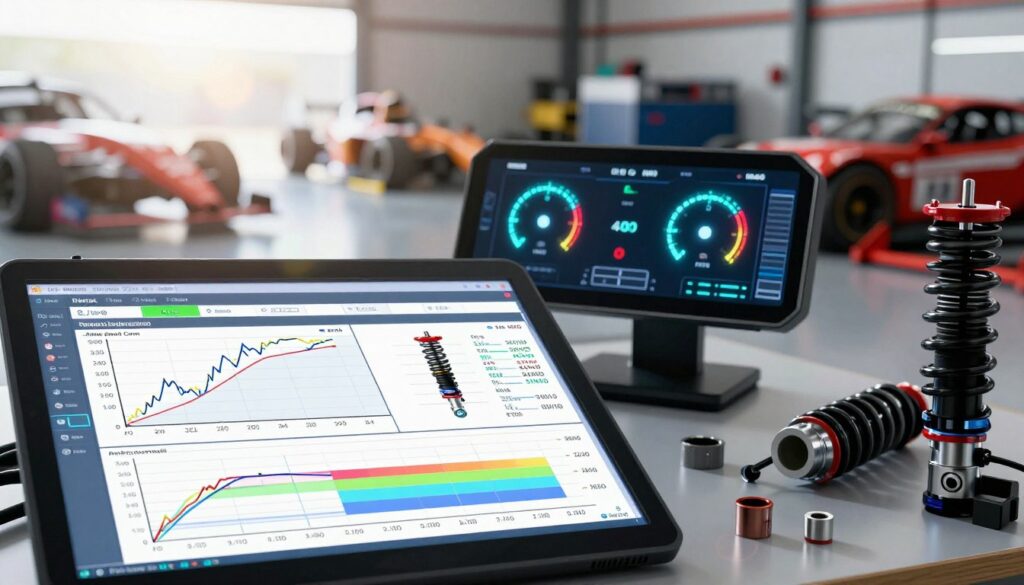
Raw data needs interpretation. A damper graph should be smooth, not wild. If it’s erratic, your car is in trouble. The data is like an EKG.
Making the Change: Iteration is Key
Data gives you a direction, not a final answer. The process is ongoing, not a one-time fix.
- Measure: Log a clean lap. This is your starting point.
- Analyze: Look at the data, not just the lap time. Find the problem.
- Adjust: Make one change at a time. This is key.
- Test: Run again and log the same data.
- Compare: See if the change worked. This is the scientific method.
The Danger of the Single-Variable Change Myth
Changing one thing at a time is critical. The “single-variable change” myth is wrong. You can’t know what caused a change without testing.
Change one thing, test, log, and analyze. Your data is only as good as your discipline.
To see the change in approach, consider this evolution:
| Aspect | The “Seat-of-the-Pants” Approach | The Data-Driven Approach |
|---|---|---|
| Feedback Source | Driver feel, engineer’s intuition, lap times. | Telemetry channels (damper velocity, suspension position, tire temps, GPS data). |
| Diagnosis | “The car feels nervous on the entry of T3.” | “The RF damper is 40% slower to extend on left-hand turn-in, see this lag in the data at the 1:12.3 mark.” |
| Adjustment Basis | Experience, historical setup notes, trial and error. | Correlation of data points (e.g., high tire temp on inside shoulder + low damper velocity = possible excessive static camber). |
| Goal | Make the car “feel” better for the driver. | Optimize a quantifiable, repeatable performance metric (e.g., minimum corner speed, average G-force, tire temp gradient). |
| Iteration Speed | Slow, based on driver runs and feedback loops. | Fast, based on immediate, objective data comparisons between runs. |
The table shows how to use data to improve a car. It’s not about ignoring driver feel. It’s about using data to make precise changes. This is how you engineer a winning race suspension setup.
Signs your setup is wrong
Your car has its own way of talking. If it understeers when you turn in, it’s not being stubborn. It’s trying to tell you something. And if it oversteers when you exit, it’s just trying to get your attention.
It’s all about listening to what your car is saying. It’s a conversation, not a one-way talk. So, pay attention to what it’s trying to tell you.
The Language of Handling: Oversteer vs. Understeer
Oversteer and understeer are like warning lights on your car’s dashboard. If it understeers, it means the front tires are struggling. The car will feel like it’s pushing wide and the steering will feel stiff.
This is a sign that the front end needs more grip. The most common racing suspension issues often start with a front end that can’t turn in. This could be due to a soft front spring or bar, or a stiff rear that won’t rotate.
Terminal Understeer and Push
When your car understeers, it’s not being stubborn. It’s overloaded. The front tires are doing more work than they can handle.
This is your car’s way of saying the front suspension is working too hard. A common culprit? An imbalanced spring or sway bar setup that’s robbing the front tires of the grip they need to turn.
Nervous Oversteer and Snap-Oversteer
A car that oversteers and snaps on corner exit is screaming about its rear suspension. This isn’t just a power issue. It’s a weight transfer and rear-end geometry problem.
The rear tires are losing grip before the fronts, a sign of a chassis that’s too loose. This is often a rear bar that’s too stiff or a spring rate that’s upsetting the balance.
The Silent Killers: Bump Steer and Aero Balance
Some problems don’t scream; they whisper. Bump steer, where the wheels steer themselves over bumps, feels like the car is darting nervously. It’s a geometry problem, not a driver error.
Your tie rods and control arms are arguing over the car’s direction. The car’s conversation becomes a shout over every bump.
Diagnosing Aero-Induced Imbalance
For cars with significant aero, the silent killer is a moving aero platform. A ride height change of a few millimeters can turn planted downforce into terrifying lift.
The car that’s planted at 150 mph but nervous at 80 mph is often talking about a shifting aero balance. The setup isn’t wrong at one speed; it’s wrong for the speed you’re at. This is the aero platform talking. Listen.