Don’t be like the eager amateur who starts packing too early. Real prep is about a careful countdown. The week before, focus on checking your gear and getting mentally ready. You’re like a general, and your race is your big mission.
Planning your race week like a military campaign helps you face the course, not your own mess.
The last 24 hours are all about careful rituals. The night before, it’s not just about wearing your number. It’s about checking everything: tire pressure, nutrition, and gear, all laid out neatly.
Race morning is for action, not for making last-minute decisions. Eat a balanced breakfast, as triathlon experts suggest. Arrive early and stay calm. This isn’t just a bike race checklist; it’s a plan to keep chaos at bay and boost your performance. Remember, control the timeline, and the timeline won’t control you.
Mechanical checks by priority
Before the race, your bike’s mechanical state is something you can control. It’s not about luck; it’s about being prepared. We’re not just checking boxes; we’re checking for possible failures. It’s like a pre-flight checklist for a fighter jet, but with more Lycra.
The goal is to make the pre race bike checklist a ritual of trust. It’s not just a list; it’s a prioritised protocol for mechanical grace under pressure.
The Contact Patch: Tires, Pressure, and Brakes
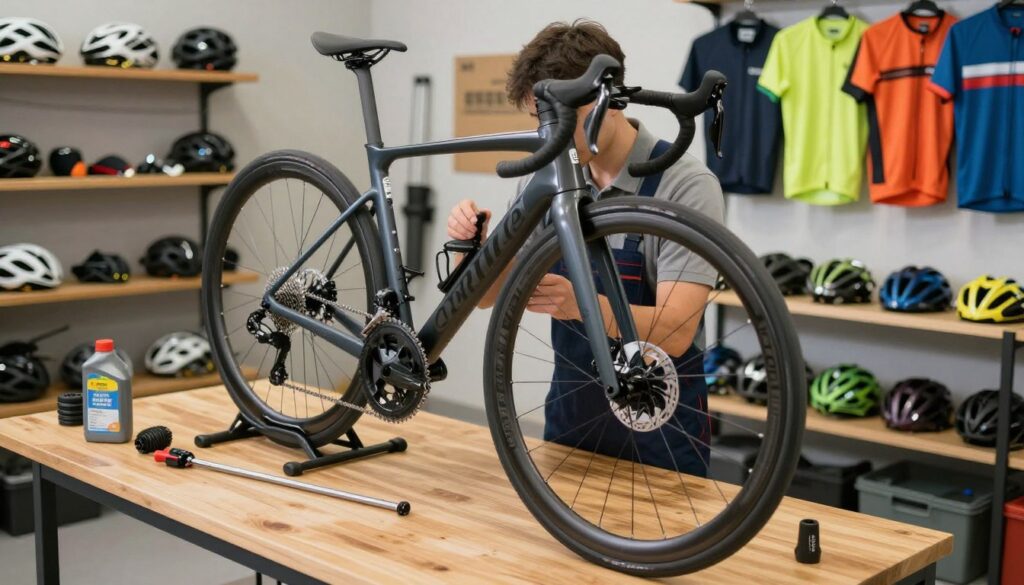
Your tires defy gravity and physics. Start with the literal point of contact. Look for tiny cuts, glass shards, and embedded gravel that could cause a puncture.
Check for even wear patterns. A squared-off rear or a cupped front tire tells you about your riding style and bike fit. Use a high-quality digital gauge for tire pressure. The difference between a hard tire and a soft one can be 5-10 PSI.
It’s not just about the number on the pump; it’s about the tire maintenance tactics that serious racers use to find that sweet spot for the day’s conditions.
Now, clamp those brakes. Spin the wheels and watch the rotor. A wobble isn’t just a nuisance; it’s a siren song for brake rub and wasted watts. Squeeze the levers. The action should be firm, with the bite point consistent and predictable.
If your brake pads look thinner than a cyclist’s patience in a headwind, replace them. The pro-tip from the pre-ride checklist for motorcycles holds true for bikes: a quick visual and tactile check of the contact patch is non-negotiable.
The Drivetrain: From Pedals to Cassette
This is where your power meets the road. The chain is the system’s lifeblood. Use the 12-link rule: a new chain should measure exactly 12 inches for 12 links.
If your 12 links stretch to 12 1/16 inches, it’s a goner. Worn chains devour cassettes and chainrings with a quiet, expensive hunger. Spin the cranks backwards. The chain should glide silently over the cassette.
Any hesitation, a stiff link, or a dry, raspy sound means it’s time for a deep clean and lube, or a replacement. Check the cassette for worn teeth—the classic “shark fin” shape on the sprockets is a dead giveaway. A barrel adjuster tweak here can be the difference between a crisp shift and a heart-sinking crunch of the chain.
This is the heart of your pre race bike checklist: ensuring power transfer is pure and efficient.
The Bolt-Check: A Ritual of Torque and Trust
This is the Zen garden of the pre race bike checklist. It’s not paranoia; it’s a systematic torque-checking sequence. Start with the contact points: handlebars, stem, seatpost, and saddle.
A carbon assembly paste is your friend for carbon-on-carbon or carbon-on-alloy contact—it prevents slippage without over-torquing. Use a torque wrench, not your calibrated bicep. Every bolt has a spec; your job is to respect it.
Check the crank bolts, the derailleur mounting bolts, and, for the love of all that is holy, your wheel skewers or thru-axles. A pro mechanic once told me, “The skewer you don’t check is the one that fails.” It’s a ritual of trust. You’re not just tightening bolts; you’re methodically eliminating single points of failure.
Data and electronics verification
In the cockpit of a modern race bike, data is key. It turns a simple ride into a strategic operation. Forgetting to check your electronics is like ignoring the instrument panel before takeoff.
A sensor glitch or a miscalibrated power meter can ruin your race plan. This section focuses on the bike’s digital system. We’re checking the data loop that turns effort into actionable intelligence.
The Data Loop: From Sensors to Strategy
Your bike is now a data hub. The loop starts with sensors, feeding data to your head unit. This isn’t just telemetry; it’s your effort’s story.
The speed sensor counts wheel revolutions, and the cadence sensor times your pedal strokes. The heart rate monitor tracks exertion, and the power meter measures your output in watts. If the power meter is the heart, the head unit is the brain, making sense of this information.
It tells you not just how fast you’re going, but at what cost. Ignoring this loop is like racing with a blindfold; you might be moving, but you have no idea of the terrain ahead.
The Bike Computer: More Than a Speedometer
Forget the old wired bike computer that just showed speed. The modern head unit is a mission control center. It’s your co-pilot, strategist, and navigator rolled into one.
It doesn’t just show your current speed; it displays your power zone, heart rate zone, gradient, and remaining distance—all on a single screen. The most critical pre-race check is ensuring it’s loaded with the correct course file. A wrong turn because of a missing waypoint can cost you the race.
It’s not just a screen; it’s your primary interface with your own performance.
The Power of Calibration: Trust, But Verify
This is the non-negotiable. Trust, but verify is the golden rule. A power meter that reads 5% high gives you a dangerous overconfidence; one that reads low is a morale-killer.
The calibration process—often called “zeroing” or “calibrating” in your device’s menu—tells your power meter, “This is zero. This is the baseline.” You must do this when the system is at a stable temperature. An uncalibrated power meter is like a liar with a stopwatch; you can’t trust a single number it gives you.
The same goes for electronic shifting. A pre-race check ensures your derailleurs are synced and your battery is charged. A dead Di2 battery mid-race is a mechanical DNF you can’t afford.
The following table breaks down the critical data points you must verify. Think of it as your pre-flight checklist for the digital cockpit:
| System | Component to Verify | Pre-Race Action | Why It Matters |
|---|---|---|---|
| Power Meter | Zero Offset / Calibration | Perform a static zero-offset calibration before the race. Check battery. | Ensures power data is accurate for pacing. A 5% error can ruin a race strategy. |
| Head Unit | GPS, Route, Battery | Load course file, check GPS signal, ensure 100% battery, mount is secure. | Wrong turn = race over. Dead unit = flying blind. |
| Speed/Cadence Sensors | Sensor magnet alignment, battery, ANT+/BLE sync | Spin wheels, check for live data on head unit. Replace batteries. | No speed data means no accurate time or distance. Cadence is key for efficiency. |
| Electronic Groupset | Battery level, firmware, alignment | Check battery level in app, ensure no error codes, test all gears. | Missed shift in a sprint or climb can break your rhythm and your spirit. |
| Heart Rate Monitor | Strap battery, sensor contact | Wet the strap, pair it, check for a steady signal. | Heart rate is your body’s tachometer. Faulty data means you can’t manage effort. |
This table isn’t just a list; it’s your pre-race data protocol. Execute it with the same discipline as your physical warm-up. In the data-driven theatre of modern racing, the podium often goes to the rider who best manages their effort. And you can’t manage what you don’t measure correctly. Verify your data, and turn information into your most powerful gear.
Nutrition and hydration integration
Forget the old carbo-loading myths. The night-before pasta feast is outdated. Today, fueling is a precise, 24-hour plan. It’s a game where you’re the master, not just about what you eat, but when and how you use it.
Adding nutrition and hydration to your pre race bike checklist makes you a winner. It’s what sets the finishers apart from those who bonk out.
Fueling the Engine: The Pre-Race Protocol
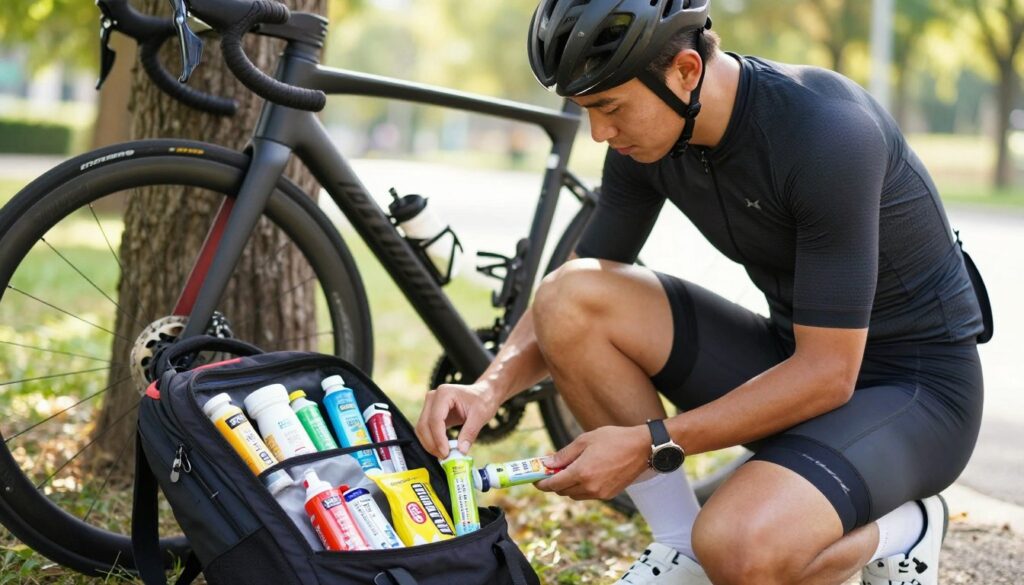
Your body is like a high-performance engine. You wouldn’t put low-grade fuel in it. Your pre-race nutrition is the high-octane fuel that makes you go strong.
The goal is to fill your muscles with glycogen, the body’s top fuel. It’s not about feeling full, but about fueling right.
The 24-Hour Fueling Strategy
The “night-before feast” is a myth that needs to be buried. True fuel loading starts 24-36 hours before. Aim for 8-10 grams of carbs per kilogram of body weight in that time.
This isn’t a free-for-all pasta party. It’s about complex carbs like sweet potatoes and oatmeal. Your last big meal should be 3-4 hours before the race. It should be a meal you’ve tested before.
The morning of the race? A light, carb-rich meal 2-3 hours before. No new foods. This is key for any smart pre race bike checklist.
The In-Race Consumption Algorithm
On-the-bike fueling is a math problem. Aim for 60-90 grams of carbs per hour. But here’s the plan:
- Minutes 0-60: Start with an electrolyte drink. Your body is using its pre-race stores.
- Hour 1-2: Start the 60-90g/hour fueling. Use a mix of simple sugars and “real food”.
- The Mix is Key: Use a 2:1 or 3:1 ratio of simple sugars to “real food”. This prevents flavor fatigue and keeps blood sugar stable.
- Electrolytes are Non-Negotiable: Sodium, potassium, magnesium are key. They help with fluid absorption. Aim for 500-700mg sodium per liter of fluid.
Think of it as a pit stop schedule. Fuel at precise intervals, not just when you feel like it. Your body can only process about 1 gram of carb per minute. Too much at once can cause stomach issues.
This isn’t guesswork; it’s metabolic management. It turns race-day nutrition into a predictable system. It’s the most critical part of your pre race bike checklist. Forget to fuel, and you’ll stop moving.
Final roll-out checklist
The minutes before a race are for focus, not panic. Your bike is ready, your body is fueled, and your mind is sharp. This is the calm before the storm, a final check to ensure everything is perfect.
The Pre-Ritual: From Kit to Kit
Before touching your bike, check yourself. Your race day kit is like your second skin. Look over your helmet, shoes, gloves, and glasses carefully. Make sure you have your license and spare socks.
This isn’t just about the gear; it’s about the ritual. Checking your kit calms your mind. It’s the practiced routine of a pro before the race starts.
The Bag of Tricks: The 10 Essential Non-Bike Items
Your race bag should be carefully selected, not a random collection. It should include things like your license, spare tube, CO2 inflator, and multi-tool. Also, pack tire levers, electrical tape, a small towel, a ziplock with electrolyte tabs and a gel, a chain tool, and a dry kit for after the race.
This isn’t just a bag; it’s your mobile pit crew. Your comprehensive pre-race equipment checklist should include these items. It turns your race bag from a hope-filled duffel into a kit of certainty.
The Mental Launch Sequence
The final check is in your mind. Visualize the start, the first turn, and the decisive climb. This isn’t nerves; it’s focus. Are you racing for a PB, a placing, or perfect execution?
Your pre race bike checklist is done. Your bike race checklist is complete. Now, the only checklist that matters is in your mind. The race is often won in these quiet, focused moments before the gun. Breathe, visualize, and launch.