When analyzing bicycle performance, riders spend countless hours and thousands of dollars chasing lighter components and stiffer frames. However, this financial investment ignores the most critical variable in the entire physics equation: the human body. The rider accounts for roughly 80 percent of the total aerodynamic drag and acts as the primary suspension system over rough terrain.
If your body positioning is inefficient, you are throwing away free speed and compromising your handling dynamics. Proper posture on the bike is not about mimicking the aesthetic of professional racers. It is a calculated manipulation of your center of gravity and frontal area to maximize mechanical efficiency. By treating your body as a tunable component, you can instantly engineer better lap times.
Aerodynamic Drag Coefficients And Free Speed
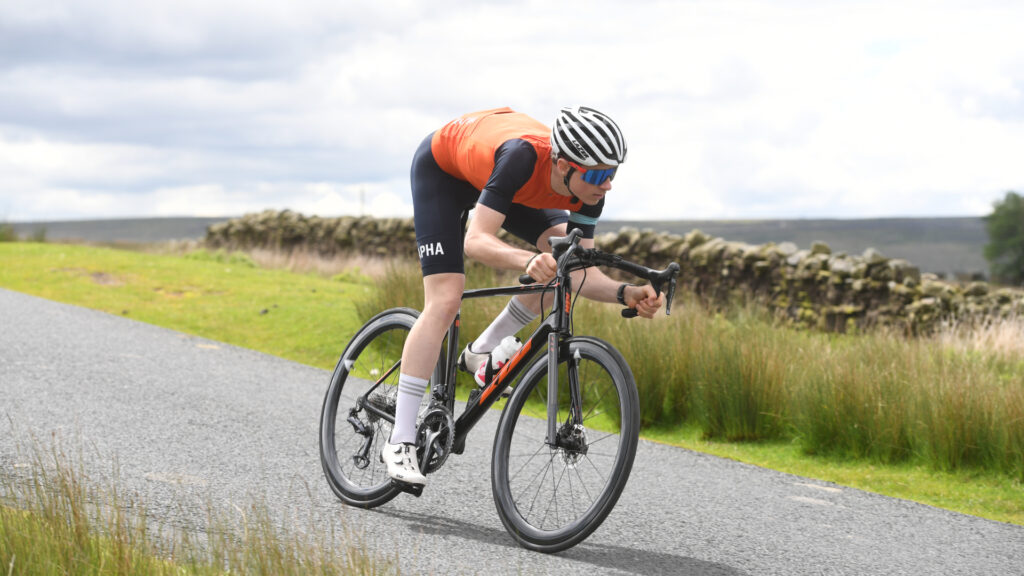
On flat roads, air resistance is your greatest enemy. Once you accelerate past 15 miles per hour, the majority of your pedaling effort is spent simply pushing the atmosphere out of your way. To go faster without burning extra muscular energy, you must reduce your Coefficient of Aerodynamic Drag (CdA). This requires minimizing your frontal area.
Many amateur racers attempt to get aerodynamic by simply dropping their head, but this leaves the chest exposed like a parachute. To properly manipulate your CdA, you must hinge at the hips and bring your torso closer to the top tube. Next, shrug your shoulders slightly and tuck your elbows inward so they sit directly in front of your knees. Independent aerodynamic drag data proves that narrowing your shoulders and bending your elbows 90 degrees can save massive amounts of watts compared to riding with straight, locked arms.
Center Of Gravity And Cornering Dynamics
Straight-line speed is useless if you have to over-brake for every turn. Cornering is a delicate balance of managing your center of gravity and maximizing the tire’s contact patch with the asphalt. When you enter a high-speed corner, centrifugal force actively tries to push you toward the outside of the turn. Your body position must counteract this force.
To maintain traction, you must drive your body weight straight down through the outside pedal. The outside crank arm should be in the 6 o’clock position, and your heel should be dropped. Simultaneously, apply downward pressure on the inside handlebar drop. This separation of forces pushes the tire tread aggressively into the pavement. Mastering these advanced riding techniques ensures your bike remains planted, allowing you to carry vital momentum through the apex of the turn.
Modulating Weight Distribution On Descents
Gravity introduces a completely new set of physical challenges. When the trail or road points downward, your center of mass naturally shifts forward over the front axle. If you encounter a heavy braking zone or a steep drop, this forward weight bias can easily cause the rear wheel to lift, resulting in a dangerous loss of control.
To counteract gravity, you must actively move your hips backward, sliding slightly off the rear of the saddle. You should drop your heels and keep your arms slightly bent to act as natural shock absorbers. When you are analyzing trail physics, this rearward shift prevents you from pivoting over the handlebars during heavy impacts. It also keeps the rear tire heavily weighted, which is critical for maximizing braking power without locking up the wheel.
Functional Core Strength For Posture Maintenance
Adopting a low, aerodynamic position or driving your weight into the pedals requires immense structural support. You cannot maintain these optimal shapes if your core muscles are weak. When your abdominal and lower back muscles fatigue, your body compensates by dumping all of your upper body weight directly onto your hands and the handlebars.
This reliance on the handlebars destroys your handling dynamics. Heavy hands make the steering feel sluggish and prevent you from making the rapid micro-adjustments needed to avoid obstacles. Building core strength for cycling is a mandatory off-the-bike requirement. A strong core acts as a solid bridge, allowing your legs to push massive watts into the drivetrain while keeping your upper body relaxed and your steering light.
Analyzing Posture Adjustments
To engineer your ride effectively, you must understand exactly how to adjust your body for different scenarios. This data table breaks down the core postural changes, what they achieve mechanically, and how they impact your overall performance metrics.
| Riding Scenario | Key Postural Adjustment | Mechanical Objective | Performance Metric |
| High-Speed Flats | Hinge at hips, elbows bent 90°, shoulders narrow. | Reduces frontal area and lowers CdA. | Maximizes straight-line speed per watt. |
| Hard Cornering | Outside pedal at 6 o’clock, heavy downward pressure. | Drives weight into the tire contact patch. | Increases cornering grip and apex momentum. |
| Steep Descending | Hips shifted rearward behind the saddle, heels dropped. | Counters forward center of gravity shift. | Prevents over-the-bars crashes and improves braking. |
| Heavy Climbing | Chest open, light grip on the bars, weight centered. | Allows maximum lung expansion and steady cadence. | Improves sustained power and oxygen delivery. |