The allure of competitive cycling often masks the sheer mechanical complexity of the human engine. You watch a Grand Tour peloton and see an effortless, fluid pedal stroke from the riders. However, beneath that seemingly smooth cadence lies a brutal physics equation dictated by torque, vector forces, and muscular efficiency.
Most amateur racers treat the crankset like a pair of stair steppers, applying massive force strictly on the downward push. This piston-like approach is inherently flawed and mathematically inefficient. A genuinely optimized pedal stroke operates more like a turbine, applying positive rotational force throughout the entire 360-degree revolution.
Transitioning from a basic downward pusher to a rider who actively manages the entire crank rotation is a thrilling pursuit. By analyzing the biomechanics of torque delivery, we can completely eliminate the energy-sapping dead spots that plague inefficient riders.
The Biomechanics Of A 360-Degree Revolution
To understand power transfer, you must understand the exact orientation of force required to move the crank arm. The most effective force is always tangential, meaning it is applied perfectly perpendicular to the crank arm itself.
When the crank arm is parallel to the ground at the 3 o’clock position, a pure downward push is 100% efficient. However, as the crank moves toward the bottom of the stroke, that downward force becomes increasingly useless. Pushing straight down at the 6 o’clock position simply drives stress into the bottom bracket bearings without generating forward propulsion.
Elite riders mitigate this by constantly altering their vector force. They push down, pull back, lift up, and drive forward in a continuous, seamless loop. This unweights the rising pedal, ensuring the downward-driving leg isn’t fighting the dead weight of the opposing limb.
Analyzing Torque Delivery And Dead Spots
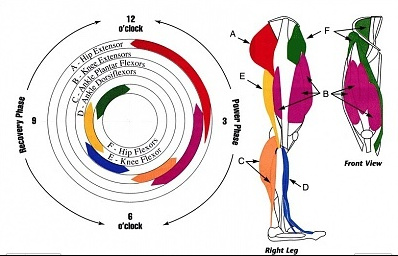
Let us analyze the most critical zones of power delivery and power loss. The top of the stroke, or the 12 o’clock position, is known as Top Dead Center (TDC). The bottom, at the 6 o’clock position, is Bottom Dead Center (BDC).
These are the natural dead spots within the pedal rotation. At both TDC and BDC, any vertical force applied by the rider translates into exactly zero rotational torque. The momentum of the bike and the flywheel effect of the wheels carry the pedals through these dead zones, but relying purely on momentum costs you micro-seconds of active power generation per revolution.
To fully illustrate the physiological demands of eliminating these dead spots, we can break down the primary muscle groups responsible for each distinct quadrant of the stroke.
| Quadrant | Crank Angle | Primary Muscle Recruitment | Vector Goal |
|---|---|---|---|
| Power Phase | 12 to 5 o’clock | Glutes, Quadriceps | Maximum downward tangential force. |
| Transition | 5 to 7 o’clock | Calves (Gastrocnemius) | “Scraping mud” backward to maintain momentum through BDC. |
| Recovery Phase | 7 to 10 o’clock | Hamstrings, Hip Flexors | Actively unweighting the pedal to prevent negative torque. |
| Preparation | 10 to 12 o’clock | Anterior Tibialis | Driving the knee forward over TDC to initiate power early. |
Muscular Fatigue And Neuromuscular Adaptation
Relying exclusively on your quadriceps for propulsion creates a localized metabolic crisis. The muscles rapidly consume available glycogen and flood with lactate, leading to premature fatigue. This is the classic profile of a rider who blows up on the final climb of a long road race.
By actively recruiting your hamstrings and hip flexors during the transition and recovery phases, you distribute the physiological load across a much broader muscular network. This is a game of marginal gains. You are asking smaller muscles to contribute a fraction of a watt each, which drastically reduces the peak load required from your primary pushing muscles.
Developing this neuromuscular pathway takes deliberate practice. It requires the brain to rewrite its deeply ingrained movement patterns. High-cadence, low-resistance spin drills are often utilized to force the nervous system to adapt to this rapid, multi-directional muscle firing sequence.
Maximizing Drivetrain Efficiency Through Constant Tension
An erratic, piston-like pedal stroke does not just exhaust your biological systems; it wreaks havoc on your machine. Micro-accelerations and decelerations within a single crank revolution cause chain slap, microscopic energy losses, and increased friction across the cassette.
Maintaining constant chain tension is precisely why drivetrain efficiency matters when translating your physical effort into forward momentum. A smooth, circular pedal stroke ensures that the tension on the chain remains uniform, allowing the rear wheel to deliver a steady stream of power to the asphalt.
Elite coaches and biomechanists rely heavily on pedaling dynamics data to analyze left-right balance and pedal center offset. This telemetry exposes exactly where a rider is losing watts to negative force, proving that true speed is engineered through perfect mechanics, not just raw physiological output.