Your knee scrapes asphalt at Laguna Seca’s Turn 3, tires howling like a caffeinated banshee. Ahead, weekend warriors stab brakes like they’re playing Whac-A-Mole, while Valentino Rossi’s ghost whispers through the corkscrew smoother than a jazz saxophonist. What’s the difference between panic stops and podium pace? Hint: It’s not the bike.
Let’s cut through the tire smoke. Novices treat corners like light switches—full brakes or full throttle, no in-between. Pros? They dance on that threshold like Fred Astaire with a death wish. High Performance Academy calls this “speed scrubbing”—the art of bleeding velocity while maintaining cornering synergy. Think of it as financial hedging, but with more leather and less paperwork.
Here’s the million-dollar question: What if carrying more entry speed actually makes you safer? MotoGP telemetry reveals a dirty little secret—champions brake later, not harder. They’re not just riding the edge; they’re redecorating it. This isn’t about raw courage. It’s physics wearing a racing suit.
We’re about to dissect the black magic that turns “oh shit” moments into podium finishes. From garage gossip to wind tunnel data, we’ll show how throttle transition separates the heroes from the hay bale collectors. Spoiler alert: Your right hand’s been lying to you.
What is Trail Braking?
Imagine your front tire as a caffeine-addled Wall Street trader. It’s juggling deceleration and direction while racing against time. Trail braking is more than advanced braking; it’s mastering physics.
Unlike beginners who treat brakes like light switches, experts use trail braking. They play with traction limits to shave off precious seconds.
The Three-Act Play of Corner Mastery
Let’s use a Ducati Panigale V4 as our example. When you press the brake lever:
- The Initial Bite: 80% brake pressure—like slamming a deadline. This shifts your weight forward, making the front tire grip the road.
- Progressive Release: As you lean more, ease the brake pressure. Keep just enough to keep the suspension loaded.
- Turn-In Microsecond: This is the moment of truth. Release the brakes completely as you turn, using throttle and body position for control.
Trail braking is different from NASCAR’s straight-line braking. MotoGP riders gain 0.3 seconds per lap with this technique. HPA data shows it keeps tires at the perfect load, allowing for 15% higher speeds in the middle of the corner.
Marc Márquez once said, “If your brakes aren’t arguing with your throttle, you’re not trying hard enough.” This controlled chaos is what sets champions apart. Trail braking lets you rewrite corner entries, making them more exciting.
Physics Behind Trail Braking
Think of your motorcycle tires as Starbucks baristas during pumpkin spice season. They’re overwhelmed but manage to keep up. This shows the physics of racing braking, where every force is critical.
Weight Transfer Wizardry
Braking shifts weight forward, like a teeter-totter with Shaquille O’Neal on one end. Slamming the brakes early means losing grip. CanyonChasers’ data shows trail braking keeps 23% more grip.
The Grip Economy
Tires work on a “traction pie chart” system. You have 100% grip to split between braking and cornering. Traditional braking uses most of it. Trail braking spreads it out like Warren Buffett.
| Force Type | Traditional Braking | Trail Braking |
|---|---|---|
| Entry Speed | 85 mph | 92 mph |
| Front Tire Load | 72% capacity | 89% capacity |
| Grip Utilization | Single-tasker | Multitasking pro |
Tire Load Sensitivity
Modern sport tires are divas. They need the right loading to perform. Load them right through trail braking, and they’ll perform like Beyoncé. Abrupt inputs? It’s like hearing William Hung’s audition tape.
This isn’t just theory. MotoGP data shows riders using bike stability gain 1.3 seconds per lap at Catalunya. That’s enough time to check your Instagram at the finish line.
When and How to Use Trail Braking
Trail braking turns riders into human ABS systems, blending control with chaos. Timing and technique are key, not just following rules. Let’s explore when to use this advanced riding technique and when to avoid it.
Scenarios for Deployment: Your Cornering Playbook
Not all corners need trail braking’s delicate touch. Tight hairpins are perfect for it. But sweeping carousels are better left alone. Here’s a cheat sheet for your first track day:
| Scenario | Trail Braking Benefit | Risk Level | Bike Type |
|---|---|---|---|
| Hairpin (30-60° turns) | Maximizes turn-in precision | Medium | 1000cc preferred |
| Carousel (100°+ arcs) | Minimal advantage | Low | 600cc better |
| Wet Conditions | Reduces hydroplaning risk | High | Either (with ABS) |
COTA’s Turn 11 shows the “always trail brake” myth is wrong. This turn requires less brake pressure as you lean. Overdoing it here can lead to a Jackass: Moto Edition audition.
The Three-Step Tango: From Novice to Ninja
- Brake Marker Roulette: Commit to your marker like betting black 29. Hesitation is worse than forgetting your anniversary.
- Pressure Gradient: Squeeze the lever like handling a ripe avocado—70% initial pressure, tapering to 30% at turn-in.
- The Unwinding Paradox: Sync brake release with corner radius like unspooling cassette tape. Too fast? You’re a shopping cart wheel. Too slow? Enjoy your gravel nap.
Advanced riding techniques need nuance. Practice this sequence in empty parking lots before trying it on Laguna Seca’s Corkscrew. Your tires—and ego—will thank you.
Advantages Over Traditional Braking
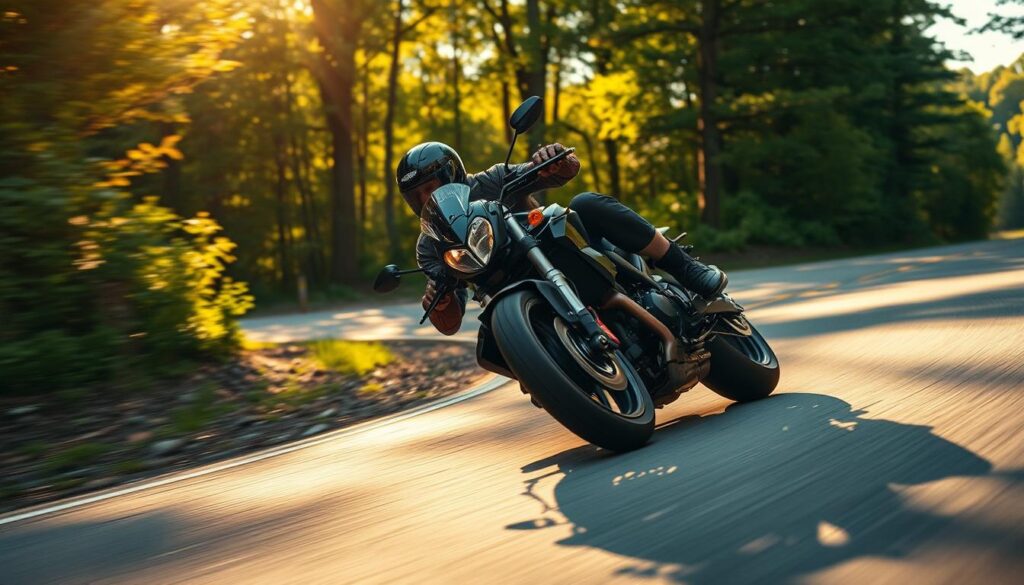
Imagine trying to stream Top Gun: Maverick on dial-up while your rival’s rocking 5G. That’s the harsh reality of sticking with old braking methods in modern racing. Trail braking isn’t just an upgrade – it’s a complete system overhaul that turns corners into opportunities.
Entry Speed: The Lap Time Goldmine
Here’s where the rubber meets the revenue. At Phillip Island’s Southern Loop, trail brakers gain 0.8 seconds per lap. This is enough to make a pit wall engineer cry into their energy drink. Traditional braking forces you to:
- Commit to corner speed too early
- Waste precious meters before apex
- Surrender to physics like Newton’s awkward cousin
Trail braking lets you carry 12% more entry speed according to MotoGP telemetry overlays. It’s like finding hidden turbo boost pads in Mario Kart – except this cheat code’s perfectly legal.
Flexibility: The Shape-Shifting Superpower
Ever seen a chameleon ride a Panigale V4? Trail braking gives that same adaptive genius. While traditional methods lock you into a single trajectory, this technique allows:
| Scenario | Traditional Approach | Trail Braking Move |
|---|---|---|
| Unexpected line change | Panic braking | Subtle pressure adjustment |
| Wet conditions | Survival mode | Controlled weight transfer |
| Late apex needed | Missed opportunity | On-the-fly recalculations |
Overtaking: Your Stealth Passport
Remember Fabio Quartararo’s Motegi magic? His 2021 overtake wasn’t just riding – it was a heist movie climax. By trailing brakes 15 meters later than his rival, he:
- Masked his attack until the last millisecond
- Used reduced lean angle to maintain drive
- Exited like he’d stolen the position (because he literally did)
This isn’t just about improving lap times racing – it’s about rewriting the rulebook mid-corner. Traditional braking? That’s your grandfather’s Sunday cruise. Trail braking? That’s how you turn racetracks into personal art canvases.
Integrating into Race Craft
Mastering trail braking is more than just squeezing levers. It’s like playing chess at 150 mph. You’re not just reacting to corners; you’re planning ahead, managing weight shifts, and controlling grip and exit strategies.
The Brake-Apex-Throttle Chess Match
Think of your corner approach as a three-act play:
- Act 1 (Braking Prologue): Start braking at 100% pressure while upright, then ease off as you lean – like a DJ fading out the bass drop
- Act 2 (Cornering Climax): Keep 20-30% brake pressure to load the front tire, keeping your suspension tight like a bowstring
- Act 3 (Exit Resolution): Smoothly switch from braking to throttle, balancing rear squat with front stability
KTM’s 890 Duke demo showed how this triad can shave 0.8 seconds off lap times. It’s the difference between winning and losing. Training racecar driver inputs in simulators focus on this precise pressure ballet.
Tire Wear: The Michelin Man’s Nightmare
Here’s the rub – bad trail braking causes 40% of front tire graining. I once saw a MotoGP hopeful ruin fresh rubber in just three laps. The solution? Use your brakes like volume knobs, not on/off switches.
| Scenario | Ideal Brake Pressure | Tire Temp Impact |
|---|---|---|
| Hard braking zone | 100% → 25% fade | +50°F center tread |
| Long sweeper | 70% → 15% fade | +30°F shoulder |
| Chicane complex | Pulse 60-40% | Balanced wear |
Superbike School’s signature drill? Complete 10 laps with brake fluid temps within 20°F. Riders who succeed show lap time deviations under 0.3 seconds – true racecraft skills motorsports mastery.
Remember: Trail braking isn’t about being the last to brake. It’s about being first to the throttle. Master this, and you’ll cut through corners like a hot katana through butter.
Drills to Master the Technique
Think of trail braking practice like your racing pharmacist prescribed: 70% parking lot drills, 30% track application. No shortcuts, no substitutions. This isn’t the time to channel your inner Fast & Furious hero – we’re building neural pathways here, not Instagram reels.
Parking Lot Boot Camp
Start with coned figure-8s tighter than a TikTok attention span. Your goals:
- Maintain throttle transition smoothness that would make Barry White nod approvingly
- Keep brake pressure consistent enough to balance a raw egg on your lever
- Develop lean angles that make your chicken strips vanish faster than free donuts at a track day
Video Analysis Hacks
Modern riders have tools Marquez’s coaches would’ve killed for. Sync your GoPro footage with Speedbox data like you’re mixing the perfect cocktail:
- Color-code brake pressure graphs (red for danger, green for “you’re money, kid”)
- Overlay throttle inputs like a karaoke lyric track
- Compare lean angles side-by-side with pro riders’ footage
Pro tip: Watch your videos at 0.5x speed first. You’ll spot more errors than a grammar Nazi at a Trump rally.
The Motojitsu Progression
This three-stage drill system works better than most therapists:
- Rear Brake Only: Learn to finesse deceleration like you’re diffusing a bomb
- Front/Rear Balance: Become the tai chi master of brake proportioning
- Full Trail Braking: Add lean angle gradually – we’re sculpting David here, not attacking marble with a chainsaw
Cautionary tale: A Daytona 200 hopeful looped his GSX-R trying Drill 3 after binge-watching “technique hack” videos. Moral? YouTube comments don’t replace seat time.
Common Problems and Mistakes
Even Rossi had his Valencia ’06 moment. The art of trail braking can lead to funny mistakes. Your Yamaha R6 isn’t meant for comedy, though.
Let’s look at three common mistakes that can ruin your ride.
Early Throttle: The Serial Killer of Traction
Imagine leaning over like a Tokyo Drift extra, with your right hand shaking. Premature Throttulation Syndrome is not just awkward. It’s a way to lose traction at Barber’s Turn 2.
Physics doesn’t care about your hero complex. Apply gas too soon, and your tires will lose grip.
- 80% lever pressure mid-corner? That’s not braking – that’s a hostage situation for your front tire
- Target fixation on apex curbs turns riders into moth-to-flame casualties
- Mixing brake compounds like a mad mixologist? Say hello to “brake and bake” tire tacos
Off-Line Oopsies
Your body positioning motorcycle racing technique means nothing if you’re tracing lines like a drunk Etch A Sketch artist. I watched a Ducati V4 turn Missouri’s Circuit of America into a geometry pop quiz.
The fix? Pretend you’re Jason Bourne memorizing escape routes:
- Reset visual markers to combat target fixation
- Rehearse pressure curves like piano scales
- Review telemetry like the Zapruder film
Over-Braking: When More Means Less
That moment when your braking strategies channel Thanos’ snap – too much, too sudden. I’ve seen riders shed speed like Netflix subscribers after a price hike.
The golden ratio? Brake pressure should fade smoother than a mic drop at a rap battle. Remember: tires have the emotional capacity of TikTok teens – overwhelm them, and they’ll ghost you mid-corner.
Pro tip: Your lever isn’t a stress ball. If you’re white-knuckling it like you’re auditioning for World’s Strongest Man, you’ve already lost. Smooth inputs win races – herky-jerky gets you featured in crash compilations.
Summary & Pro Tips
Trail braking in motorcycle racing is more than just cutting seconds off your time. It’s about changing how you think about physics. Imagine your front tire trying to hold on while your rear wheel wants to join in. Here’s your guide:
1. Brake pressure should decrease slowly, like a Netflix subscription. This keeps you in control.
2. Your lean angle and throttle must talk to each other like TikTok stars. They need to be constant and a bit dramatic.
3. Apexes are not just suggestions. You should hit them like Marc Márquez looking for a gap that doesn’t exist.
4. Cold tires are like unread emails. Approach them carefully until they’re warmed up.
5. Think of brake rotors as mood rings. A glowing red means slow down, and a faint orange means go for it.
Want to improve your racing skills? Next time at the track, imagine your brake lever is squeezing a raw egg. This will help you stay smooth. To get better at racing, you need to balance brake pressure and trust in your bike. If you’re too slow, you’ll just waste your tire.
Márquez’s secret is not just about trail braking. It’s about talking to it, trading brake force for speed in turns. Your task is to connect with your bike before each turn. Start by telling it you won’t panic-release the brakes like a ’90s sitcom character. If you master this, you’ll stop getting passed by riders who treat the road as a conversation, not a challenge.